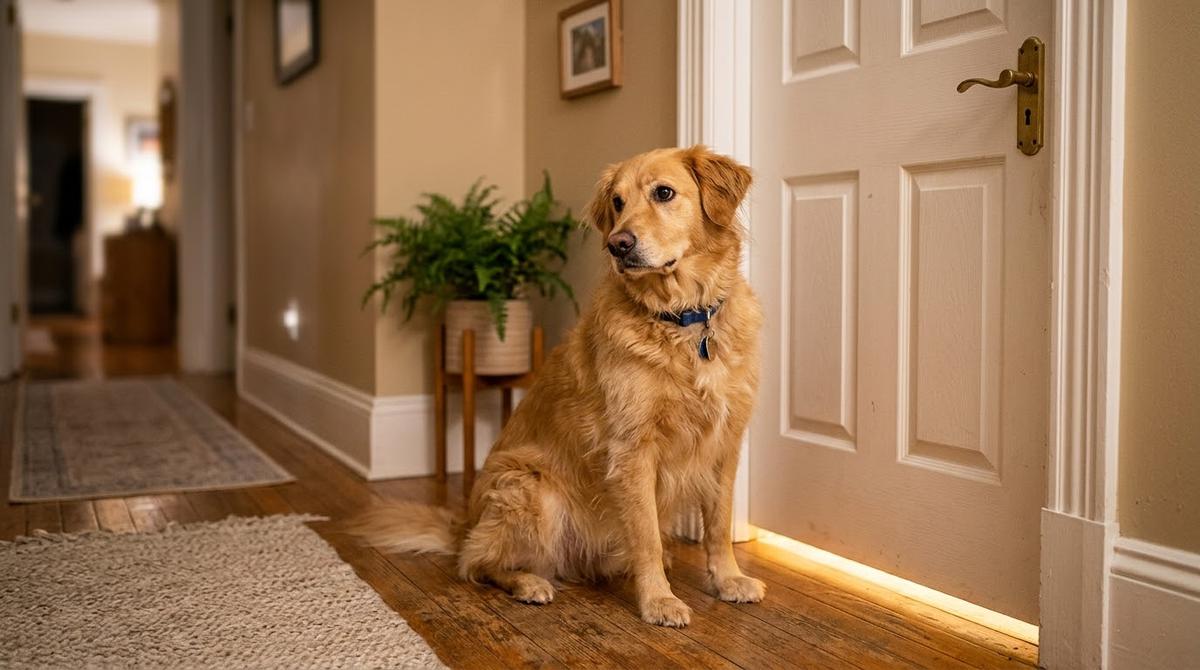
3 AM. Freezing cold. I was half-asleep, dragging myself toward the bathroom. I opened the door, slipped inside, and reached to latch it shut. There, wedged into the two-inch gap before the frame met the latch, was a cold, wet nose.
It was Buster, my rescued Golden Retriever mix. He stared up at me with deadpan seriousness through the dark. I stood there shivering, barefoot on cold tile, having a silent staring contest with a dog who apparently believed my 30-second bathroom break required armed escort. Yes, I know exactly how ridiculous this sounds. But if you have ever tried to close a bathroom door in a house with a dog, you know you are never truly alone.
For years, I wondered if I was doing something wrong, or if my dogs just had an unnatural obsession with porcelain fixtures. The truth turns out to be far more fascinating.
Why Does My Dog Follow Me to the Bathroom?
If you have ever felt a soft nudge against your knees while sitting on the toilet, rest assured: your dog is not broken. This behavior is so common among canine companions that animal behaviorists consider it virtually universal across breeds, ages, and personality types.
We view the bathroom as a sanctuary of absolute personal privacy. Your dog, however, views it through an evolutionary lens that predates indoor plumbing by tens of thousands of years. In the canine world, privacy does not exist, but vulnerability does.
1. The Pack Instinct Never Left
Wild canines do not wander off into secluded rooms by themselves. In a natural pack structure, sticking close to group members is not a preference—it is a survival mechanism. Being alone in the wild usually means you are lost, injured, or exposed to predators.
When you walk down the hallway and step into a small room, your dog's ancestral brain registers movement from the pack leader. Following you isn't a calculated decision; it's a hardwired reflex. To your dog, "alone time" is an abstract human concept that defies every instinct of social survival.
2. You Are the Safe Zone
Underneath all that fur, your dog relies heavily on you for emotional stability. In veterinary science, this is studied through secure attachment theory—the exact same psychological dynamic observed between human infants and their parents.
You represent food, comfort, predictability, and safety. When you shut a door, you temporarily cut off access to that safe zone. Understanding why dogs suddenly become clingy helps contextualize why a closed door feels like an unnecessary barrier to an animal whose whole world revolves around your presence.
3. The Bathroom Is the Most Vulnerable Room
Here is something I learned after spending years observing canine dynamics in shelter environments and home visits: elimination and grooming are high-vulnerability moments in the animal kingdom. When wild animals do their business or rest in confined spaces, they are at their most defenceless.
When you enter the bathroom, your dog recognizes that you are engaging in a routine where your attention is paused. In their eyes, standing watch outside the door—or sitting directly at your feet—is an act of protective duty. They are keeping guard so you can handle your business in safety.
"Early in my career, I assumed dogs followed us into bathrooms out of sheer curiosity or boredom. It took working with dozens of anxious rescues to realize it's actually an ancient pact: 'I watch your back, you watch mine.'"
So the next time a wet nose pushes open the door while you're reaching for the hand towel, remember that it comes from a place of deep-seated loyalty. But what happens when this sweet habit crosses the line into unhealthy obsession?
Is This Behavior Actually Healthy?
I get asked this question almost every week by concerned pet parents: is it normal for my dog to follow me like a shadow, or am I accidentally fostering a codependent nightmare? In most cases, having a little shadow trailing your footsteps to the sink or shower is a sign of healthy attachment. It means your dog feels bonded to you, trusts your presence, and finds comfort in simply being in the same room.
Dogs are incredibly tuned into our emotional frequencies. Long before we consciously notice our own stress levels rising or mood shifting, our canine companions have already picked up on subtle olfactory and postural cues. Recognizing how your dog knows you're sad before you do explains why their desire to stay glued to your side often spikes when you're having an off day or feeling under the weather.
When Following Becomes a Red Flag
However, there is a distinct boundary between loving companionship and panic-driven obsession. When a dog cannot tolerate being on the opposite side of a door without spiraling into distress, we are no longer dealing with simple loyalty—we are looking at clinical separation anxiety.
Here are the warning signs that your dog's bathroom-following habit might be rooted in anxiety rather than affection:
- Pacing and whining: Excessive vocalization or frantic pacing outside the door the moment it clicks shut.
- Destructive scratching: Digging at the carpet, chewing the door frame, or trying to force the door open with their paws or snout.
- Panting and drooling: Physical signs of distress like heavy panting or drooling even during a brief two-minute separation.
- Inability to settle: The dog cannot relax anywhere else in the house if you are behind a closed door, even if another family member is giving them attention.
If your dog displays several of these distress signals every time you shut a door, it is worth consulting with a certified veterinary behaviorist to address underlying anxiety before it escalates.
What I Tested With My Own Dogs (And What Actually Worked)
Years ago, when I was living with an overly anxious Terrier mix named Barnaby, I made every mistake in the book. Early in my career, I tried the brute-force method: I locked the bathroom door and completely ignored his high-pitched squeals from the hallway, believing he would eventually "figure it out." He didn't. Instead, he shredded three inches of hallway carpet down to the bare subfloor in under five minutes.
Realizing my approach was failing miserably, I shifted gears toward positive desensitization. I started by leaving the bathroom door slightly cracked so Barnaby could see I was still there, slowly building up his confidence over several weeks until he felt safe enough to wait comfortably on his dog bed in the hallway.
5 Practical Strategies That Respect Your Dog's Needs
If you prefer a little personal space during your morning routine without causing your companion distress, try these proven strategies:
- 1. Create a "Stationing" Spot Outside the Door: Place a comfortable mat or dog bed just outside the bathroom doorway. Teach your dog a "go to mat" command so they have a designated job to do while waiting for you. This satisfies their desire to stay close without invading your personal space.
- 2. Provide a High-Value Distraction: Offer a long-lasting chew or a stuffed frozen treat toy right before you step into the bathroom. This shifts their mental focus from monitoring your movement to enjoying a rewarding sensory activity.
- 3. Desensitize Door Movement: Practice opening and closing doors throughout the day without actually walking away. Touch the doorknob, swing the door shut, open it immediately, and walk away calmly. This removes the cue that a closed door means long-term abandonment.
- 4. Keep Transitions Low-Key: Avoid making a dramatic fuss when you leave or re-enter the room. Enthusiastic apologies or overly emotional greetings reinforce the idea that your temporary absence was a significant, scary event.
- 5. Respect Their Boundaries and Yours: Remember that setting reasonable boundaries isn't cruel—it builds confidence. Gradually increasing independence in small, successful increments helps your dog feel secure whether you're right beside them or behind a closed door.
"I used to think that letting my dogs follow me everywhere was the ultimate proof of love. It took a ruined carpet and an exhausted terrier to teach me that true love also means giving them the confidence to feel safe when a door comes between us."
Now that we've covered the behavioral mechanics and real-world solutions, let's bust a few persistent urban legends surrounding this funny daily ritual.
3 Myths About Dogs Following You (Debunked)
Over the years, I've heard every wild theory imaginable regarding why our four-legged shadows insist on invading our personal space. Let's set the record straight on three of the biggest myths floating around pet forums today:
Myth 1: It's a clear sign of alpha dominance. Old-school training theories claimed that a dog following you into the bathroom was trying to assert control over your territory. Modern veterinary behaviorists have thoroughly debunked this idea. Following you isn't about power or dominance; it's about comfort, safety, and social connection.
Myth 2: Purebred dogs do it more than mixed breeds. Many people believe that specific breeds like Golden Retrievers or Shepherds are uniquely obsessed with following their owners, while mixed breeds are more independent. In reality, while velcro-breed traits exist, bathroom tracking is an environmental and emotional behavior shared equally across all canine lineages.
Myth 3: They only follow you because they want treats or food. While your dog certainly won't say no to a kitchen snack, their bathroom vigil isn't motivated by stomach rumblings. They are drawn to the concentrated scent profile of small spaces. In fact, exploring why dogs sleep in your shoes reveals just how much comfort they derive from our personal scent marks, especially in quiet areas like bathrooms and bedrooms.
Frequently Asked Questions
Why does my dog follow me to the bathroom?
I asked my vet this exact question after Buster followed me for the tenth time in one morning. She laughed and said something I never forgot: "Your dog doesn't understand doors. To him, a closed door is just a wall you built between yourself and the pack." That hit me hard. I started watching him more closely and realized he wasn't being clingy at all. He was doing what dogs have done for thousands of years — keeping his family within sight. It is instinct, not obsession.
Is it bad if my dog follows me everywhere?
Not usually. When Barnaby, my anxious terrier mix, followed me room to room, I panicked and thought I had created a monster. But my behaviorist told me something simple: a dog who follows you calmly is a dog who trusts you. The problem only starts when the following turns into panic. If your dog cries, scratches doors, or cannot settle when you leave the room, that is different. That is anxiety, not affection. Trust me, I learned the difference the hard way.
Do dogs follow you because they love you?
I used to roll my eyes at this idea. Then I read the research on oxytocin — the same bonding hormone that floods a mother's brain when she holds her baby. When your dog is near you, that same chemical releases in their brain. So yes, they follow you because being near you feels good. It is not just loyalty. It is chemistry. And honestly, that made me feel a little guilty for ever closing the door on Buster.
How do I stop my dog from following me to the bathroom?
I tried everything with Barnaby — locking the door, ignoring him, even yelling once (which I still regret). Nothing worked. What finally helped was giving him a job. I placed a small mat outside the bathroom door and taught him "go to mat." Within two weeks, he started waiting there calmly instead of scratching the door. The trick is not to push your dog away. It is to give them something to do while they wait. That changed everything for us.
Does following behavior mean separation anxiety?
Not automatically. I made this mistake with Barnaby — I assumed his following meant he had separation anxiety. My vet corrected me gently. "Following is normal," she said. "Panic is not." The real signs of anxiety are heavy panting, drooling, destructive scratching, or crying the moment you leave. If your dog just wants to be in the same room as you, that is not a disorder. That is a bond. Understanding the psychology behind constant licking helped me see the difference between comfort habits and true distress signals.
Why does my dog stare at me while I'm in the bathroom?
The first time Buster stared at me through the bathroom crack, I felt judged. But a trainer friend explained it simply: dogs stare because they are reading us. Your face tells them if you are happy, stressed, or in danger. In the bathroom, you are quiet and still — so they watch more intently. It is not weird. It is their way of checking in. Once I understood that, those long stares stopped feeling creepy and started feeling kind of sweet.
Final Verdict: It's Not Weird — It's Love
At the end of the day, having a fluffy bodyguard leaning against your bathroom door isn't something to worry about. It is a quiet, funny, and deeply genuine reminder of the ancient bond we share with our canine companions.
They don't care about personal boundaries or human social etiquette. All they know is that where you go, the pack goes. So the next time you see a cold nose peeking under the door frame, take a moment to laugh and appreciate the unwavering loyalty standing guard on the other side.
Does your dog have a hilarious bathroom routine or insist on being your personal escort? Share your funny stories and experiences in the comments below!


No comments:
Post a Comment
Join the discussion below. Please keep your comments relevant to the topic (Pet Care) and respectful. Your experience is valuable to our community!